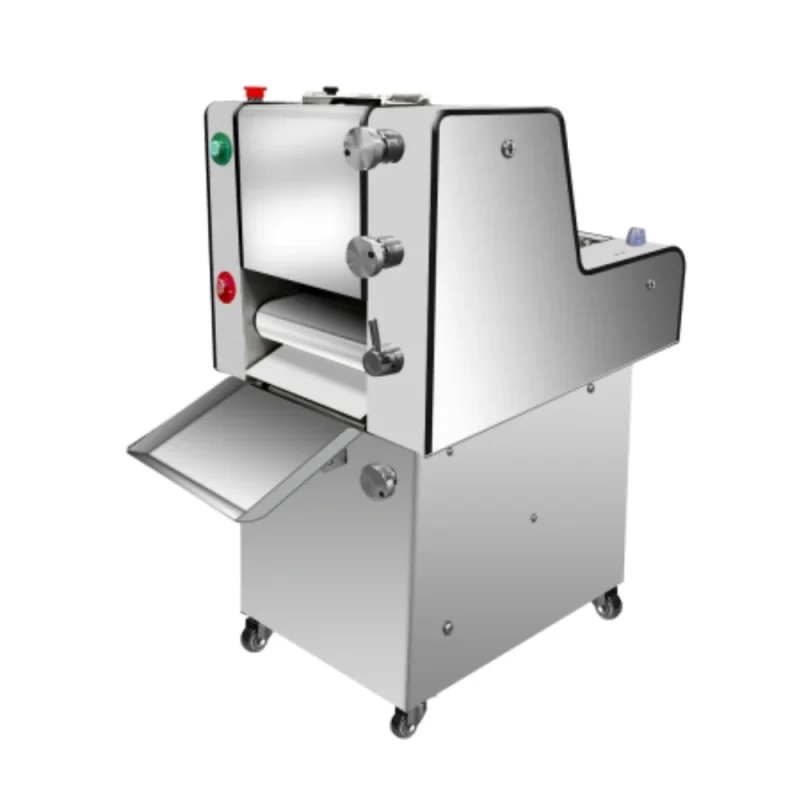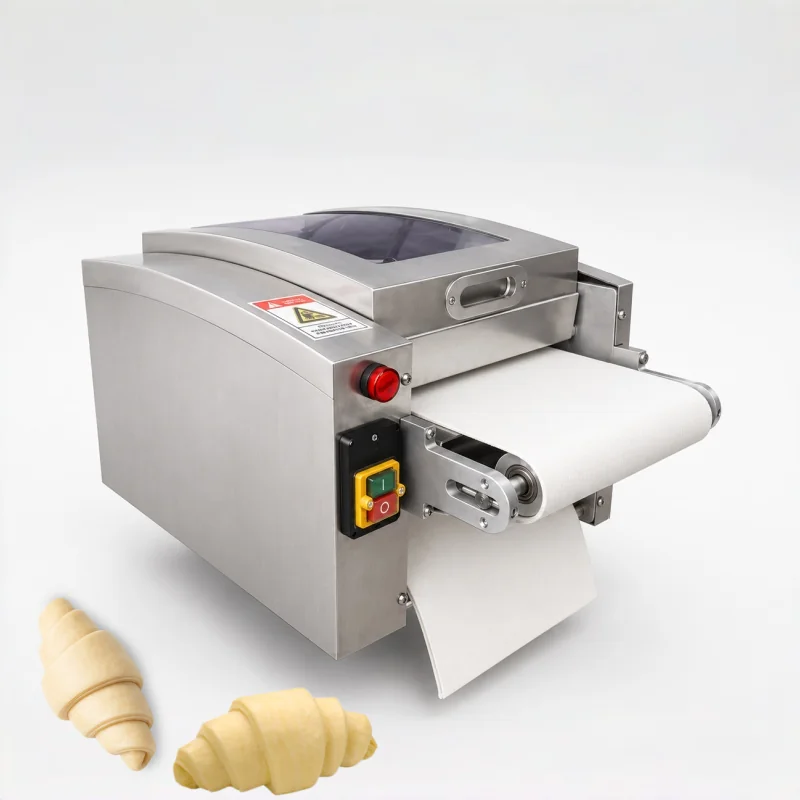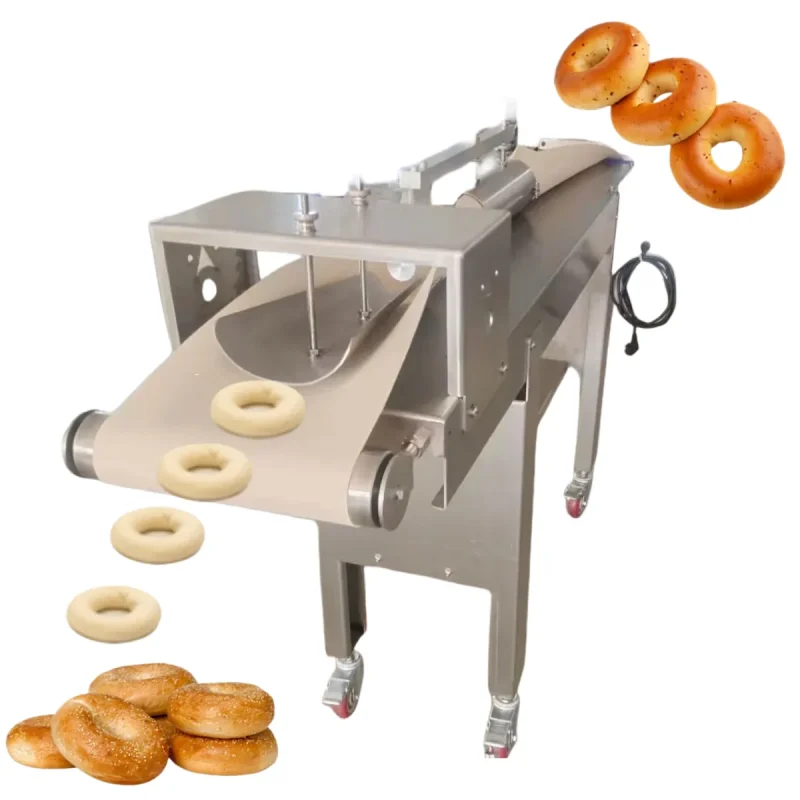




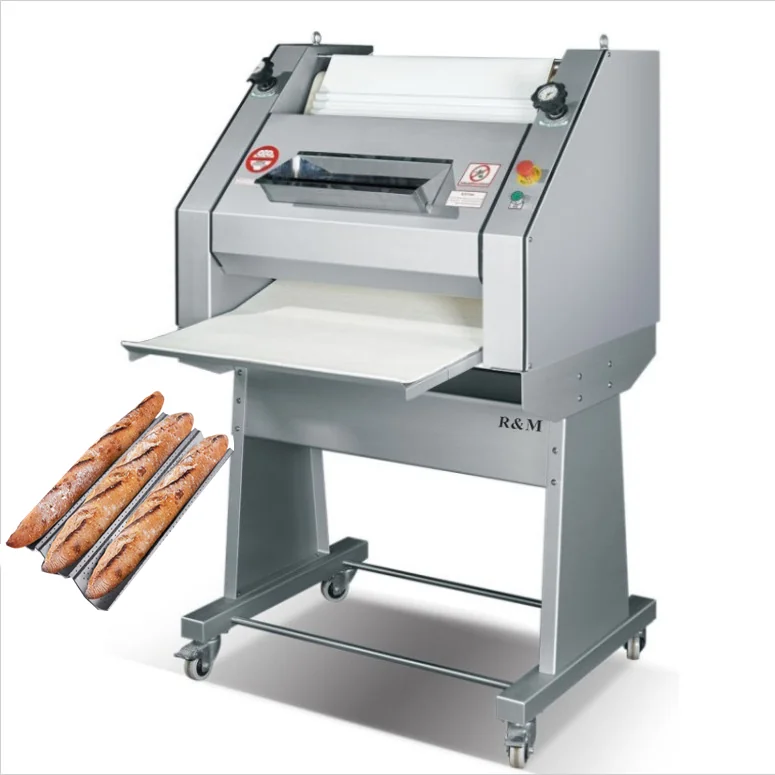


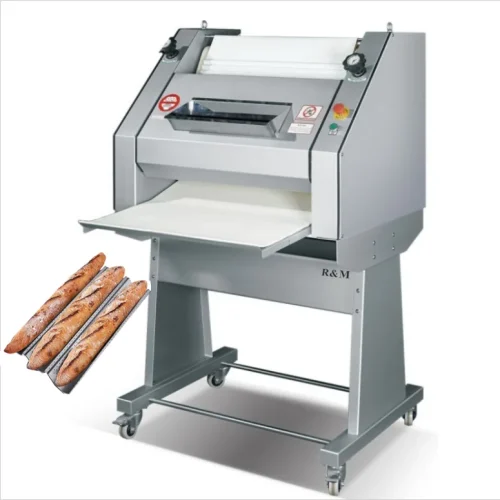
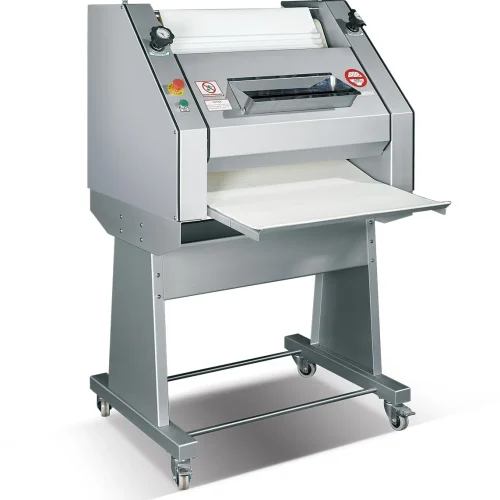
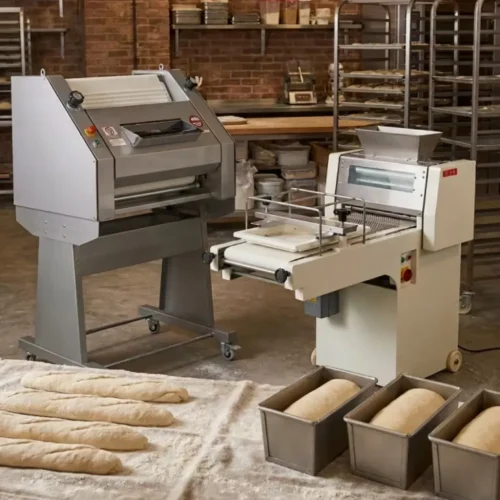
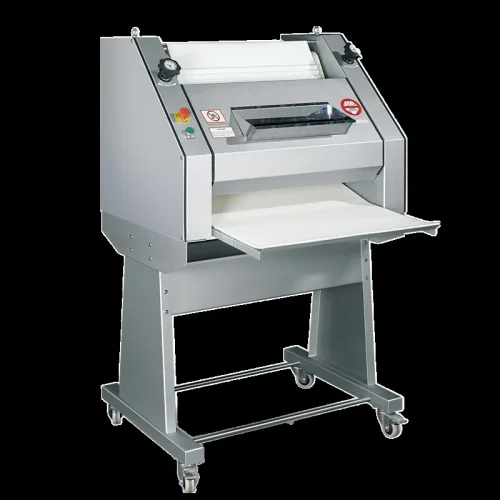
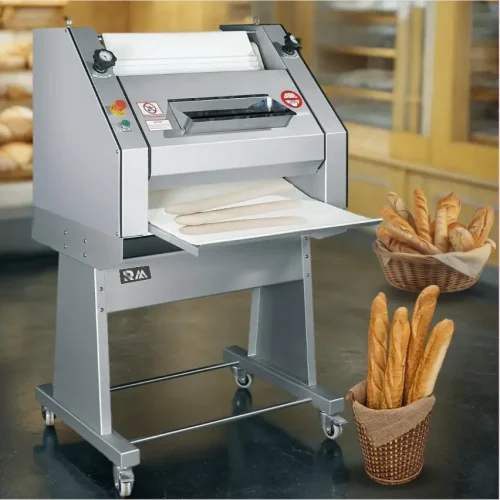
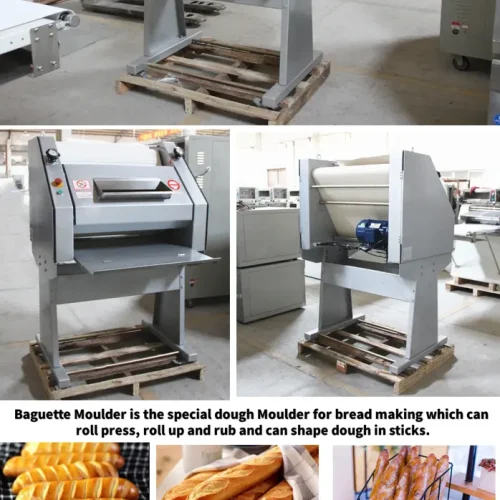
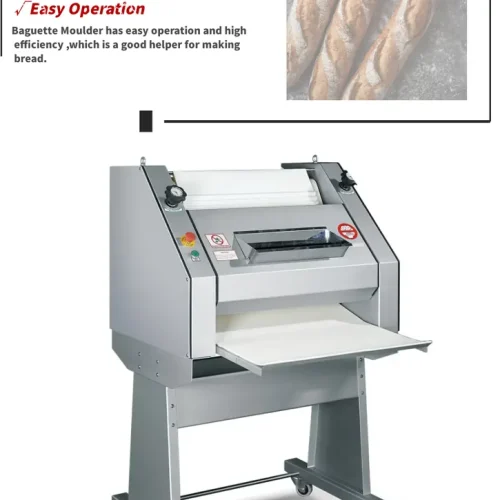
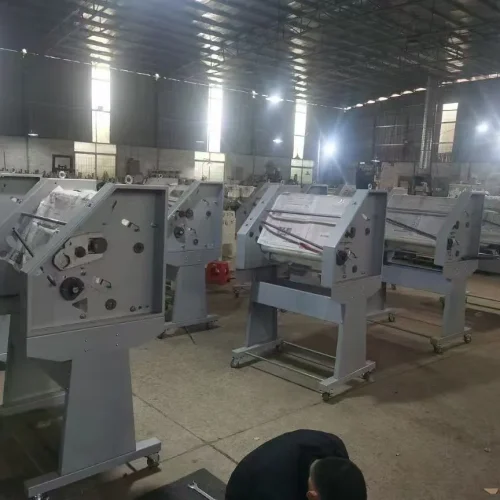
Baguette Moulder Machine RMZ-750 — 1200 Loaves per Hour, 50 to 1250g
The RMZ-750 is R&M’s heavy-duty commercial baguette moulder built for chain bakeries and centralized production facilities. It handles dough from 50g to 1250g and outputs up to 1,200 shaped loaves per hour. Two-stage belt rubbing, food-grade stainless steel rollers, and calibrated gap adjustment are standard. 220V or 380V; 110V/60Hz conversion available for North American markets.
Demander un devis
Indiquez la quantité souhaitée et ajoutez-la à votre liste de devis pour obtenir un devis.
Détails du produit
Baguette Moulder Machine RMZ-750 — 1200 Loaves per Hour, 50 to 1250g
The RMZ-750 is R&M’s heavy-duty commercial baguette moulder built for chain bakeries and centralized production facilities. It handles dough from 50g to 1250g and outputs up to 1,200 shaped loaves per hour. Two-stage belt rubbing, food-grade stainless steel rollers, and calibrated gap adjustment are standard. 220V or 380V; 110V/60Hz conversion available for North American markets.
Specifications
| Parameter | Value |
|---|---|
| Modèle | RMZ-750 |
| Dimensions | 700 × 970 × 1,450mm |
| Dough weight range | 50–1,250g |
| Output capacity | Up to 1,200 loaves/hour |
| Wool thickness | 5mm |
| Power | 1KW |
| Net weight | 320kg |
| Tension | 220V/50Hz or 380V/50Hz (110V/60Hz optional) |
| Packaging size | 830 × 1,100 × 1,600mm, 350kg |
Contact us for wholesale pricing and OEM options.
How This Machine Shapes a Baguette
Understanding what the RMZ-750 does mechanically helps buyers evaluate whether it matches their production workflow. The RMZ-750 baguette moulder takes a pre-divided dough piece and runs it through three sequential operations in a single pass. Each operation is driven by a separate mechanical stage, so operators can isolate and adjust any step of the shaping process independently.
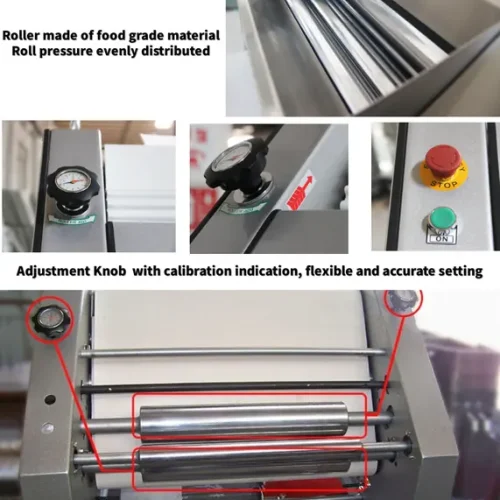
1. Initial rolling (flattening): On this baguette moulder, the first stage flattens the dough: the piece enters the machine and passes through the adjustable press roller. The gap between the roller and the conveying board is set with the calibration handwheel on the left (range: 0–19mm). This flattens the dough into a strip, degassing it and aligning the gluten. The result is a uniform sheet with consistent thickness from edge to edge, which is the precondition for an evenly shaped finished loaf.
2. First stick rubbing (rolling up): The second stage of the baguette moulder initiates the first rolling-up action: the flattened strip is covered by the front conveying cloth with press roll. This begins the transformation from flat sheet to cylinder, forming the dough strip into a rough cylindrical shape while expelling the residual air trapped during the flattening pass.
3. Second stick rubbing (elongation and tightening): The baguette moulder completes the sequence with a speed differential rubbing action: the dough baton passes between the front and back conveying belts, which run at different speeds — 46m/min and 39m/min respectively. The speed differential creates a rubbing action that elongates and tightens the dough, producing a firm, even baguette shape with good surface tension. The controlled friction also develops a thin, dry surface film that scores cleanly and opens evenly in the oven.
The length of the finished piece is controlled by the right-hand handwheel, which adjusts the gap between the front and back boards (range: 0–41mm). Both handwheels have calibration indicators — operators can reproduce settings across shifts without trial and error.
The output drops into a receiving plate, ready for proofing.

Why Dough Weight Range Matters — 50g to 1,250g
Most baguette moulders on the market handle dough in the 100–600g range. The RMZ-750’s 1,250g upper limit is a meaningful practical difference.
A standard French baguette is typically 250–300g of dough. A larger 60cm baguette runs 350–400g. Pain de campagne and large country loaves can run 600–800g. The RMZ-750 handles all of these — and extends further into larger long bread formats (Vietnamese baguette, large French sticks, and long dinner rolls) that approach or exceed 1,000g. In production planning terms, a 250–300g dough piece yields a finished 60cm baguette of roughly 200–240g after bake loss — the exact format that supermarket in-store bakeries and hotel breakfast buffets order in the highest volume, so the machine’s mid-range output covers the workhorse SKU of most wholesale bakeries.
At the lower end, 50g covers mini baguettes, breadsticks, and small long bread rolls — formats increasingly popular in hotel buffet and catering supply contexts. Mini baguettes at 50–80g are a standard canapé and banquet format, while breadsticks in the same weight class run in continuous production for retail snack lines and restaurant bread baskets.
The RMZ-750 baguette moulder’s 1,250g ceiling is not an abstract specification for operators running long-format programs: at 80–120g per piece, a standard bánh mì run uses the lower end of the range, while large festive loaves and extended sandwich bread in the 800g–1,000g class use the upper end — both on the same machine with no changeover between them. For a central kitchen or wholesale bakery supplying multiple product formats in the long bread category, the RMZ-750’s weight range covers the full menu without needing a second machine.
Built for High-Volume Daily Operation
320kg frame — stable under continuous load: A baguette moulder that weighs 320kg carries the structural weight needed to sustain the rolling and rubbing forces without frame flex or vibration. The mass is not incidental: the four-leg H-frame and cross-braced stand distribute the dynamic load of the two conveying belts evenly across the floor contact points, so the machine holds its geometry even when the belts are running at full speed against heavy dough. Lighter machines with similar claimed outputs often show roller drift and shaping inconsistency after sustained high-volume use. The RMZ-750 is designed to run all-day shifts in central bakery environments.
Food-grade stainless steel rollers: Every dough-contact surface on this baguette moulder is stainless steel with a food-grade non-stick treatment. This resists the flour-fat-water environment of bread dough production without surface degradation. Stainless also simplifies daily sanitation: the smooth surfaces wipe down quickly between batches, and the non-stick treatment reduces dough residue build-up on the rollers and conveying boards, which keeps cleaning time short at the end of a shift. Roller pressure is distributed evenly across the full width, preventing the edge-heavy pressing that causes uneven degassing and irregular loaf diameter.
Large-capacity dough inlet: The wide intake on this baguette moulder lets operators place dough pieces quickly without hunting for the feed point. The front belt and intake area are wide enough to receive dough pieces placed quickly by operators working at speed. This is a practical detail for high-output operations where the operator’s loading pace sets the effective throughput ceiling — a narrow or awkward inlet creates a bottleneck that the machine’s rated capacity cannot overcome. In practice, the generous opening reduces hand-eye adjustment per piece, and that saving compounds into minutes of extra production per hour across a full shift.
Adjustable feet and universal wheels: The machine has levelling feet for stable installation on uneven floors, and universal casters for repositioning within the production area. Once positioned and levelled, the feet lock the machine in place. The front casters carry lock pedals, so the unit can be fixed firmly during operation and released for cleaning access or line reconfiguration in under a minute — a practical detail for bakeries that rearrange their production floor between seasonal runs.
Applications
French baguette and long bread production: The machine’s primary application and design target. Central kitchens supplying supermarkets, restaurant chains, hotel food and beverage departments, and retail bakeries rely on this baguette moulder as the core shaping step in their baguette production line. For the origin and production of the classic long format, see the independent article on baguettes. The 1,200-loaf-per-hour rating matches the daily volumes these supply contracts demand, and the two-stage rubbing produces the even surface tension and scoring-friendly skin that retailers expect from a finished baguette.
Vietnamese-style baguettes (bánh mì): Vietnamese baguettes (bánh mì) are a major category in Southeast Asian bakery production. At 80–120g per piece and long thin format, they are ideally suited to the RMZ-750’s lower weight range and precision elongation capability. In Vietnam, where bánh mì is a national staple, bakeries commonly run the machine continuously through morning and lunchtime production windows; the same unit then switches to larger banquet loaves in the afternoon without any mechanical changeover.
Large French sticks and country bread: Operations producing 600–800g long bread formats — pain de campagne, large pullman loaves in long shape, or oversized baguettes — use the upper weight range. Few machines accommodate this format; the RMZ-750 baguette moulder does, with the right-hand handwheel extending the finished length as the recipe requires. This makes it the practical choice for bakeries that sell both standard baguettes and premium large-format country bread from the same line.
Toast loaves (initial forming step): Before a toast dough piece enters a sandwich tin, it is typically rolled and shaped. The RMZ-750 handles this initial forming step for toast production, creating a tight, even cylinder that fills the tin uniformly during proof and bake. Because the machine runs the same roll-and-elongate sequence as hand moulding, the switch from manual to machine forming does not change the dough’s final crumb structure — only the speed and consistency of the shaping step improve.
Hotel and catering supply: Fresh baguette supply to hotels, banquets, and catering operations often runs on tight daily schedules with high piece counts. The 1,200 loaves per hour capacity covers the volumes these contracts require. Banquet schedules typically front-load baguette shaping into a two-to-three-hour window before service; the RMZ-750 completes the entire day’s shaping inside that window and frees staff for finishing, scoring, and baking tasks.
How the RMZ-750 Compares to the RMZ-280 Mini Dough Moulder
Le RMZ-280 is R&M’s compact dual-function moulder — lighter (145kg), lower power (0.37KW), and designed for smaller dough pieces (30–350g). It is the right machine for a small independent bakery or café.
The RMZ-750 is the right machine when:
- Your dough pieces regularly exceed 350g
- Your daily output runs in the thousands of loaves
- You need continuous all-day operation without operator intervention
- Your kitchen has a permanent dedicated shaping station with industrial electrical supply
If you are setting up a new small bakery and want to explore which model fits your planned output, contact us — we can size the right machine for your volume.
Foire aux questions
What is the difference between the RMZ-750 and the RMZ-280?
The RMZ-750 handles 50–1,250g dough, produces 1,200 loaves per hour, and weighs 320kg — it is the heavy-duty industrial choice. The RMZ-280 handles 30–350g, is lighter at 145kg, and has a compact 0.37KW motor — it is designed for small to medium bakeries. The RMZ-750 is for chain bakeries and central kitchens; the RMZ-280 is for independent bakeries and small operations.
Does the machine handle Vietnamese-style baguettes?
Yes. Bánh mì dough at 80–120g per piece is well within the RMZ-750’s range and the long, thin format produced by the rubbing mechanism matches the bánh mì shape. The length adjustment handwheel controls the finished piece length.
Can this machine shape toast loaves?
Yes, for the initial rolling and shaping step before tin loading. The machine forms the dough into an even cylinder ready for the tin. It is not a tin-loading machine — the shaped piece still needs to be placed into the loaf tin manually or by a tin-loading system.
Does the machine degas the dough?
Yes. The initial roller press stage applies controlled pressure that degasses the dough piece before the rolling-up stage. Thorough degassing at this step is important for an even crumb structure — trapped large gas pockets in baguette dough produce an irregular, uneven crumb.
What is the 110V option?
The RMZ-750 standard specification runs on 220V/50Hz or 380V/50Hz. A 110V/60Hz single-phase conversion is available for buyers in North American markets where 220V is not the standard commercial supply.
What accessories are included?
Standard configuration includes the forming roller set. Dust covers and transport trolleys are available as optional add-ons. Contact us to specify your requirements at order.
Get a Quote
Industrial baguette moulder for long bread production. Up to 1,200 loaves per hour. The RMZ-750 baguette moulder covers the full long bread range from 50g mini sticks to 1,250g country loaves with a single operator managing the feed. Compare the full bread dough moulder range for other models.