





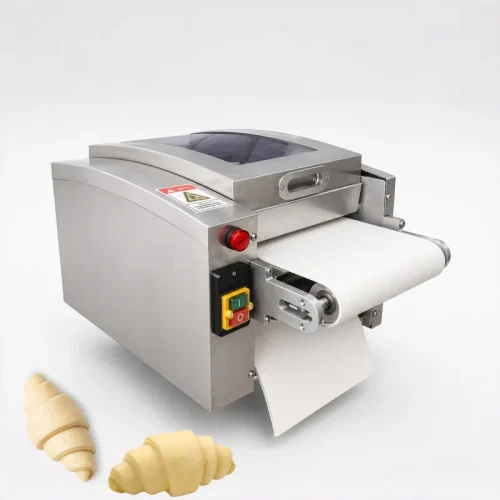
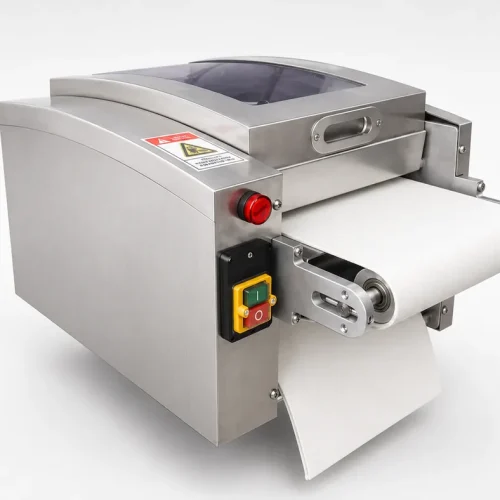

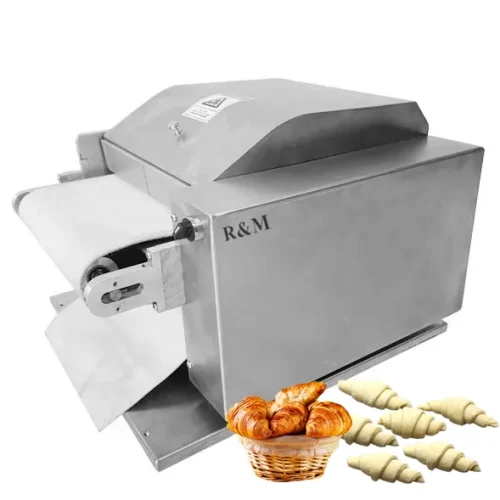
Croissant Moulder Machine — Semi-Auto Rolling, 1 to 7mm Dough Thickness
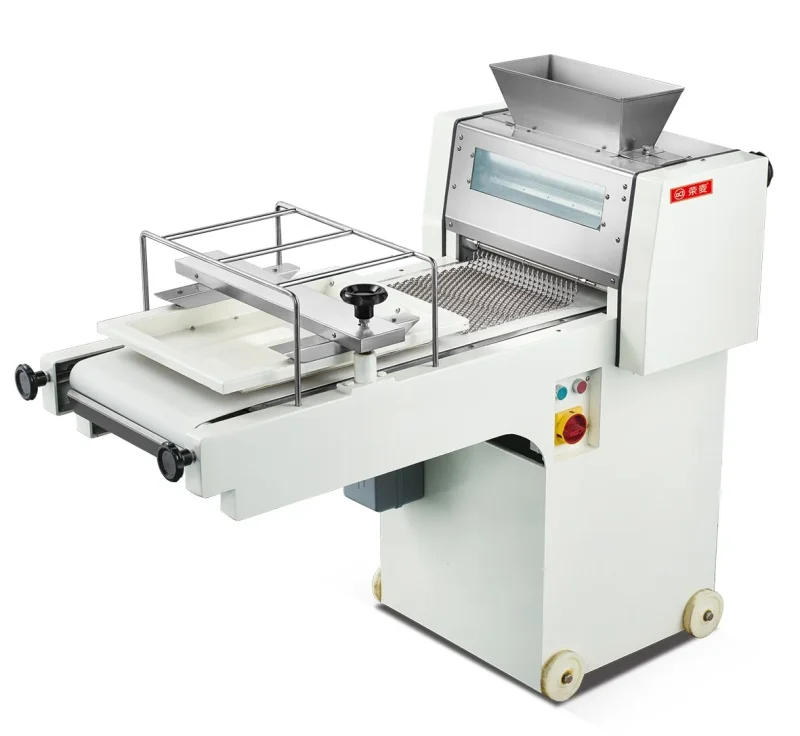
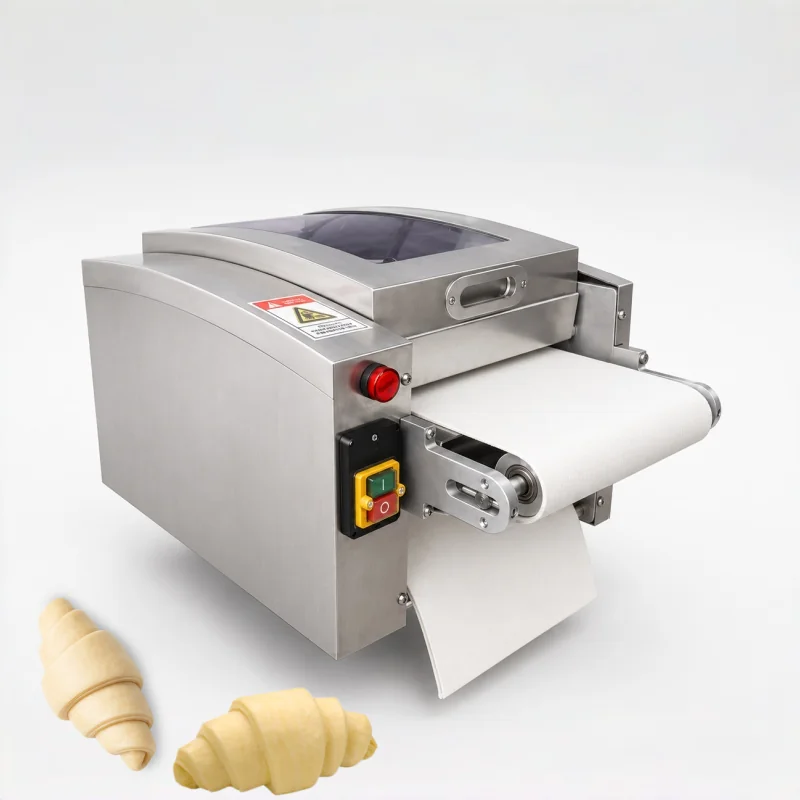
The GD-CM01 is a semi-automatic croissant moulder that rolls pre-cut triangular dough pieces into finished crescent shapes automatically. The operator places each triangle on the machine; the machine rolls it. No hand-rolling, no inconsistent tension. At 37kg and 0.12KW, it fits any bakery counter. Pairs directly with R&M’s dough sheeter with cutter function for a complete croissant dough processing line.
Request a Quote
Enter the quantity you need and add to your quote list for pricing inquiries.
Detalles del producto
Croissant Moulder Machine — Semi-Auto Rolling, 1 to 7mm Dough Thickness
The GD-CM01 is a semi-automatic croissant moulder that rolls pre-cut triangular dough pieces into finished crescent shapes automatically. The operator places each triangle on the machine; the machine rolls it. No hand-rolling, no inconsistent tension. At 37kg and 0.12KW, it fits any bakery counter. Pairs directly with R&M’s dough sheeter with cutter function for a complete croissant dough processing line.
Specifications
| Parameter | Value |
|---|---|
| Modelo | GD-CM01 |
| Dimensions | 650 × 480 × 350mm |
| Croissant dough thickness | 1–7mm |
| Potencia | 0.12 KW |
| Net weight | 37 kg |
| Voltaje | 220V/50Hz (110V/60Hz optional) |
Contact us for pricing, lead time, and bundle options with the croissant sheeter-cutter.
What Semi-Automatic Means in Practice
A fully manual croissant requires the baker to hand-roll each dough triangle from the wide base toward the tip. Done correctly, this produces good surface tension and a clean tip that holds its shape during proof. Done quickly under production pressure, it produces inconsistent tension, irregular tip length, and variable finished croissant size.
The GD-CM01 automates the rolling step while keeping the operator in control of placement — the core of a semi-auto croissant moulder. The workflow is:
1. Cut laminated croissant dough into triangles (by hand or with the sheeter-cutter)
2. Place the triangle on the GD-CM01 with the wide base at the machine inlet, centered
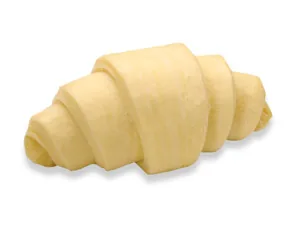
3. The machine rolls the triangle into a crescent shape automatically
4. Remove the shaped croissant and place on the baking tray
The machine handles the rolling action — consistent tension, consistent number of rolls, consistent tip tightness — on every piece. The operator’s role is placement and removal: fast, low-skill, repeatable.
Note on triangle placement: The triangle must be placed straight and centered on the belt. A crooked placement produces a croissant that rolls off-axis. This is the one technique detail that requires a brief learning curve for new operators.
Dough Thickness: 1 to 7mm
The GD-CM01 croissant moulder is designed for laminated croissant dough at standard sheeting thicknesses. The 1–7mm range covers the working range of most commercial croissant sheeting workflows:
- 3–4mm: Standard commercial croissant sheet thickness for a normal-size croissant
- 4–6mm: Slightly thicker sheet for a larger or more substantial croissant
- 6–7mm: The upper range, suitable for brioche-style or thicker laminated croissant
The machine is not suitable for dough thicker than 7mm — attempting to roll very thick dough through the mechanism can stall the motor or produce an uneven roll. Start the sheeting process with a properly laminated, correctly sheeted dough at your target thickness.

Pairing with the R&M Sheeter-Cutter for a Complete Line
The GD-CM01 croissant moulder most naturally pairs with R&M’s dough sheeter with integrated cutter roller (RMQ-520-CUT). This two-machine combination covers the full dough-to-shaped-croissant workflow:
RMQ-520-CUT: Takes laminated croissant dough, sheets it progressively to the target thickness (0.5–38mm range), and cuts it into uniform triangles using the integrated cutter roller. The cutter mold produces consistent triangle dimensions — same base width, same height, same notch — on every piece.
GD-CM01: Receives those cut triangles and rolls them into finished crescents automatically.
Without the sheeter-cutter, the operator cuts triangles by hand (slower, less consistent triangle dimensions). With it, the full process from laminated dough sheet to shaped croissant runs on two machines with minimal manual intervention.
Contact us to discuss both machines as a bundled purchase — we can advise on the right sheeter-cutter configuration and belt width for your production volume.
Why Consistent Croissant Rolling Matters
In artisan croissant production, visual consistency is part of the product’s value proposition. Customers at a bakery display case notice if some croissants are tightly rolled with a clean tip and others are loosely wound with a splayed end. In a wholesale supply context, the buyer notices size and shape variation across a batch.
The GD-CM01 eliminates the variation that comes from hand-rolling under time pressure:
Same number of rolls on every piece — the machine completes the same rolling action regardless of which piece is being processed
Same tip tightness — the mechanism produces a consistent tip on every croissant, which holds its shape through proof and baking
Same overall diameter — consistent rolling tension produces consistent finished croissant diameter across a batch
For a bakery producing 100–500 croissants per session, the reduction in variation directly improves the visual appeal of the finished tray and reduces waste from pieces that rolled incorrectly.
For the technique behind laminated croissant dough, see the independent article on croissants.
Croissant Moulder Applications
Commercial bakeries adding croissant to the product range: A bakery setting up croissant production for the first time often hand-rolls the first batches. As volume grows, hand-rolling becomes the production bottleneck and the quality inconsistency becomes visible. The GD-CM01 replaces the hand-rolling step at a compact, low-cost entry point.
Café and hotel pastry kitchens: Hotel breakfast pastry programs and café kitchens producing fresh croissants daily benefit from the consistent output quality and the time saved per session. A trained operator can process 200–400 pieces per hour with the GD-CM01 — significantly faster than hand-rolling at equivalent quality.
Wholesale croissant supply: A bakery supplying fresh croissants to cafés, restaurants, or retail outlets needs consistent batch quality. The machine’s consistent rolling produces visually uniform croissants that meet wholesale buyer expectations.
Preguntas frecuentes
How do I use a croissant moulder?
Place the pre-cut laminated dough triangle on the machine with the wide base at the inlet and the triangle centered. The machine rolls it automatically into a crescent shape. You then place the finished croissant on a baking tray for final proofing and baking. The key technique is correct triangle placement — straight and centered — to produce a symmetrical roll.
What dough preparation does this machine require?
The dough must be laminated (butter folded into the dough) and sheeted to your target thickness (1–7mm for this machine) before cutting into triangles. The GD-CM01 handles only the rolling step — it does not laminate or sheet. See the R&M sheeter-cutter (RMQ-520-CUT) for the upstream sheeting and cutting step.
Can I use this machine without the R&M sheeter-cutter?
Yes. You can cut the triangles by hand from a sheeted dough and feed them into the GD-CM01. The machine rolls any triangular laminated dough piece in the 1–7mm thickness range. The sheeter-cutter is an optional upstream upgrade that improves triangle consistency and cuts processing time.
Does this machine work with pain au chocolat or other croissant variants?
The GD-CM01 rolls triangular pieces. Pain au chocolat uses a rectangular piece folded around chocolate — a different shape — and is not compatible with this machine. Croissant variants that use a triangular base (plain, almond, cheese-filled triangles with a seam) work.
What is the output rate?
Output rate depends on the operator’s placement speed. With a trained operator, 200–400 pieces per hour is achievable. The machine rolls one piece per cycle; the cycle time is short — the limit is the operator’s placement and removal speed.
Get a Quote
Semi-auto croissant rolling machine. 37kg countertop. Pairs with R&M sheeter-cutter. Optional 500mm downstream conveyor available on request. See the full bread dough moulder machine range for more shaping options.